
NOVA x OOFBEADAM: An Interview on Moving Pixels in 2025
OOFBEADAM is less a name than a release — a cry against the ordinary that became a visual diary, a cultural lens, and a living archive of a generation learning to see itself again.
In this conversation, we dive into Can’s journey from Istanbul’s visual chaos to Milano’s aesthetic discipline, the evolution of his poetic instinct into design, and the question shaping Türkiye’s graphic memory today:
Can a poster stop informing and start feeling?
Our guest: İstanbul-born graphic designer and visual storyteller Can Gülertan, known online as OOFBEADAM.
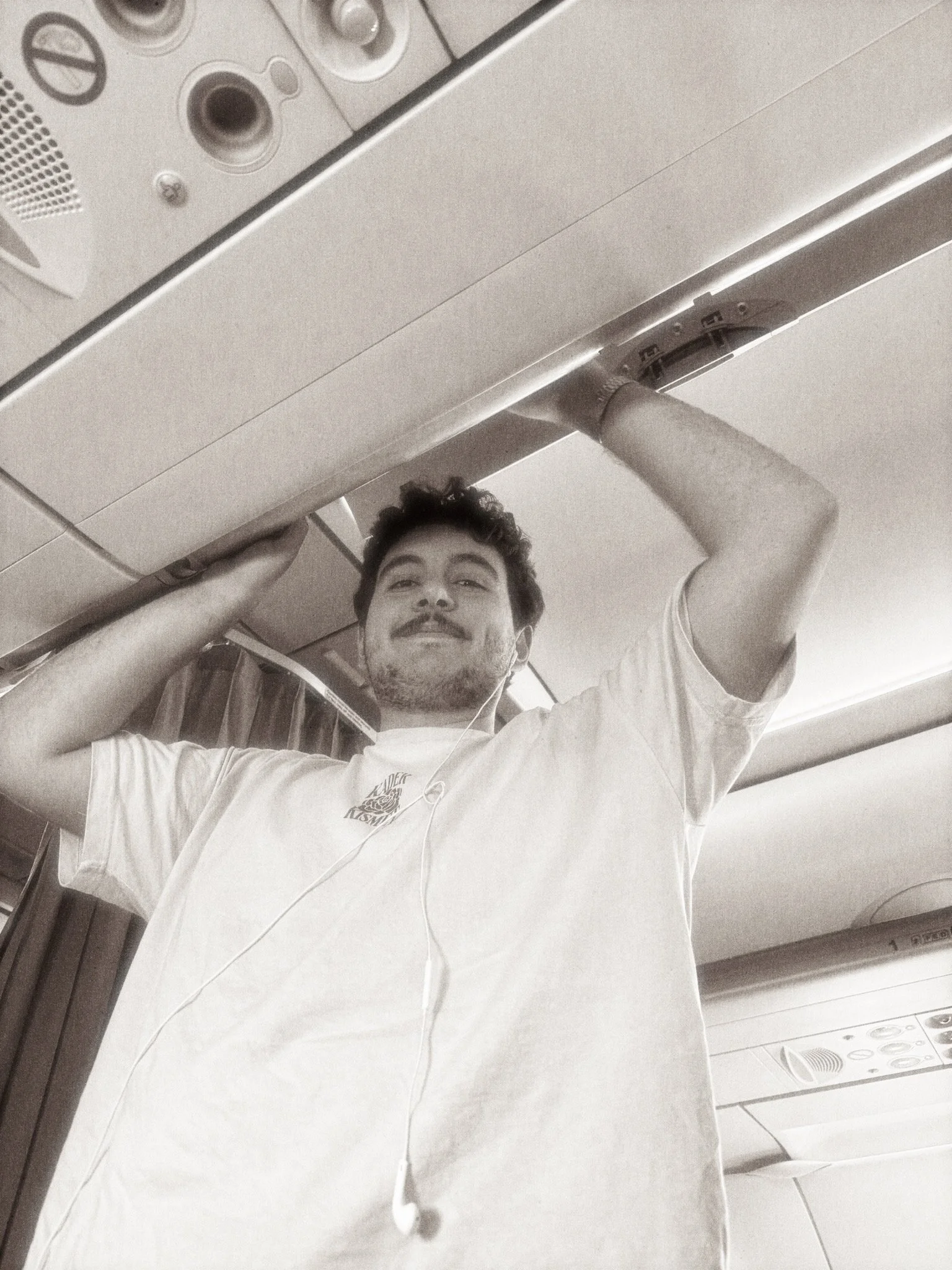
Can GÜLERTAN aka “OOFBEADAM”
NOVA: We’re very happy to have you with us, Can. First, for those who don’t know you: who is Can, what kind of visual world did he grow up in, and how is he reshaping that world today?
CAN: First of all, thank you so much for having me!
My name is Can, and I was born and raised in Istanbul. Above everything, Istanbul is what helped me define myself the most. I grew up with this enormous city that holds the streets I spent my life in, the people I met, and the memories I made.
As I turn 25, being able to call myself a designer truly makes me happy. I spend my life moving pixels, creating visual solutions that allow people to express themselves — and that forms an ecosystem of its own.
As hard as it is to believe, I’m still new to the profession I now make a living from. I’ve always been deeply interested in visual arts and design, but I never opened a single Photoshop file until I turned 20. If I had known how much freedom of expression design would give me, I’m sure I would have started earlier.
If I talk about the visual world I grew up in: my family environment was always one that encouraged me to create things. My parents are the kind of people who try to immortalise every moment by photographing it. The importance of photography and visual memory in our home pushed me toward visuality in a very strong way. And later on, being surrounded by people who didn’t limit my self-expression encouraged me to always keep creating.
Throughout my creative journey, I’ve always had incredibly important people by my side. Being able to talk with my girlfriend as if I’m speaking to a creative director, asking my friends for ideas to get feedback, showing my work to my professors as if I were showing it to a colleague — all of this gave me courage, and I’m grateful for the support they’ve all given me.
I actually began creating by writing poetry. Being able to describe what I saw prepared me in a remarkable way to recreate those things on a blank page in later years. My creative process evolved from poetry to painting, and from painting to design. Whatever came into my hands, I tried to use it to tell my own story — some attempts succeeded, some stayed archived with me, and some are still somewhere in my house waiting to be rediscovered.
NOVA: Could you tell us how the name OOFBEADAM came to be?
CAN: OOFBEADAM is basically a cry — a reaction against everything ordinary. It’s a phrase you throw out when someone annoys you, when you feel suffocated, or when what’s being said no longer makes sense: you just let out a big “OOOOOFBEADAM!” and feel relieved.
If you’re asking, “What does this have to do with design, Can?” — that’s actually a very good question. I don’t fully know the answer myself. Like all the projects I’ve ever started, OOFBEADAM is just a voice from within that ended up turning into a brand.
I’m always like this when it comes to naming things.
NOVA: How did your master’s program at NABA change your perspective on Turkey’s design culture? The perspective you gained there — is it, at its core, something that distances you from local identity in favour of “trend”?
CAN: Even while I was at NABA, a part of me was always in Istanbul. So my master’s was a process where I never fully disconnected. In my head, I was constantly comparing the crowded streets of Istanbul to the tourist-filled squares of Milan.
I think it’s useful to say this: Milan is a metropolis where aesthetic concern and outward appearance are at their peak. Istanbul, on the other hand, is a mystical creature where everyone tries to exist at the same time, and that the whole world has been fascinated by for centuries.
From a design perspective, with everything I learned, deciphering Turkey’s and Istanbul’s design culture is almost impossible. The reason is that understanding the decisions behind most design products in Turkey requires cultural knowledge. The font choices, colors, the placement of signs, the A4 papers in Comic Sans containing extremely important information, the shop names written in sparkling letters… I could give countless examples, but what I’m trying to explain is that the design processes behind these things are dictated by cultural needs.
As for distancing oneself from local identity: I’m a designer who likes to add a little piece of myself into every design I create. Some people argue that this is not logical, that the designer should remain invisible in the final product — but I completely disagree. To me, design is a medium through which you can make your voice heard with colors and compositions. And for that reason, the knowledge and perspectives I gained in Milan gave me the opportunity to make my voice heard by more people.
NOVA: Designing a poster every day for 365 days. How was this idea born? What challenged you the most, and what transformed you the most in the process?
CAN: The 365 Project emerged at the intersection of boredom and opportunity, I’d say. I was in Leiden, the Netherlands, for Erasmus, sitting with my housemate at the dining table in the middle of our cold living room. A paper I needed to write was staring at me, and inside me, the urge to create was overflowing.
At that time, I still wasn’t using any Adobe applications — they intimidated me. I closed the Word file with the essay and opened Figma. I created a 1080×1080 canvas, stared at my laptop for a bit, and realised that designing is a very reasonable way to have fun while expressing myself. I made a simple poster and saved it to my desktop.
Right after that, something inside me said, “Make one more,” and I think that’s where it all started. I don’t know what made me think I could do it every day, but intoxicated by the feeling of creating, I made a folder called “365”.
Ten minutes later, I announced on OOFBEADAM’s Instagram that I would design something every day.
The hardest part wasn’t designing — it was coming up with ideas every single time. But whenever I did get an idea, it made me unbelievably happy.
During the project, no matter where I was, if an idea came, I’d open my laptop immediately. Bars, a bench at night, bus stations, airports, train rides — catching ideas in mid-air was the most important part of the project for me.
The most rewarding part was how each poster created its own world and brought new opportunities with it. Many design pages reposted my work. I got the chance to print and see some posters in the real world. Posters I made for loved ones helped me immortalise moments. The page where I expressed myself eventually became a bridge connecting me to the world.
NOVA: 365 days, 365 posters. At some point, did design become automated?
CAN: I wish.
NOVA: Usually, when we look at a poster, we expect it to demand something from us: an exhibition invitation, a product, a warning. But in your posters, this relationship reverses — the poster becomes a surface that thinks, not one that informs. This conceptual shift has long been accepted in European and American design scenes. Do you think that here, in Turkey, we can normalize posters that don’t “announce” something but “make you feel” something?
CAN: Absolutely. I think people in Turkey have so much to say, and the world of design can easily become the home for those things. At the end of the day, a composition is created with the intention of conveying an issue. In that sense, design can carry feelings instead of information.
I continue my profession by accepting that the “rules” of design are merely recommendations. I’ve learned so much from them, but once I learned how to break them, I realised I could express myself much more effectively.
I sincerely recommend that anyone interested in design try expressing themselves in poster form.
NOVA: As someone living in Turkey but educated abroad, you feel the winds of both worlds. On one side, an age where artistic production becomes invisible and technical skill dominates; on the other, a crisis of quality lost in excessive content. In this transition era, what are the hardest — but maybe also the most meaningful — aspects of being an independent designer?
CAN: I think independence comes with dilemmas. My work doesn’t follow a fixed schedule, doesn’t have a fixed place, draws inspiration from schools without necessarily obeying them.
Having no authority binding me to anything makes me incredibly free in expressing myself. But it also means that the consequences of drifting can be much greater. As the line between my designer identity and my self becomes blurred, work becomes life and life becomes work.
Moving back and forth in this tension is probably the hardest but also the most inspiring part for me.
“I see the melancholy of blue in everything created in Turkey; nothing feels complete unless it has passed through sorrow.”
NOVA: At some point, your posters almost become a diary — a personal archive. Do you think graphic design can be one of these forms of memory? Like in your case, can graphic design carry the visual memory of a country, a person, or an era — and beyond that, shape a cultural identity?
CAN: Absolutely! Think about the lettering you see in markets, the logos around you every day, the graphics on yogurt containers used as plant pots, the hand-painted “no parking” signs on walls, or the graffiti you pass by daily. All of these register into a country’s design memory and eventually shape its design culture.
As someone who grew up influenced by this culture, I can say that every design element we witness affects the decisions we “new generation” designers make — and will continue to do so.
NOVA: How would you describe Turkey’s visual memory today? Which eras, names, or colors form the building blocks of that memory?
CAN: A single word is enough: chaos.
As for eras — that’s a much harder question, because Turkey’s visual memory is an organism that has been continuously kneaded by a centuries-long past and adds something to itself every day. So abstract concepts feel more logical to me here.
Let’s go with colors and names, because eras alone could fill an entire conversation.
“At some point, that page became a bridge connecting me to the world”
For color, I choose blue — because I see the melancholy of blue inside almost everything created in Turkey. As Sezen Aksu says, songs that haven’t passed through pain are incomplete.
I could name hundreds of people, but I think I want to say: all of us. Anyone in Turkey who has lifted a pen and transferred themselves onto a page has contributed something to this country’s visual memory. I say this out of deep respect for the dedication behind creating something in an environment where expression has become harder, and where so many voices shout at the same time.
NOVA: There was a time — festivals, exhibitions, music, youth culture… everything felt brighter, more sincere, more unique. At least, looking back now, that’s what we all tend to say. From the matches we watched to the cassettes we listened to, from TV intros to juice packaging at the supermarket — everything had a character and a color. Today, when we see the slightest trace of those times, the flutter we feel is really an echo of that memory.
Of course, behind that feeling are the iconic designs, visual languages, and graphic identities of the golden era between the 1970s and 2000s.
But in the past twenty years, cultural, political, and technological shifts gradually erased that memory, replacing it with visuals that look increasingly similar. Products and brands have also moved toward minimal, stripped-down design tendencies. As societies become more interconnected, we ironically lose what makes us unique.
Do you think our lack of a strong graphic design archive and visual memory as a country is a reflection of this cultural erosion — from global to the smallest local? Or do you think there is still a spark of “visual identity” somewhere, waiting to be revived?
CAN: I think those sparks will always exist. In the past, expressing yourself was enough to be heard because the noise was much lower. But today, you must first be heard and then express yourself, because the world is now governed by an economy of attention. Everyone demands our attention, and with our limited resources, we try to find something to be inspired by.
At exactly this point, the responsibility of the individual to research becomes much more important. Being curious, researching what we love, what we value — all of this matters more than ever. Walking through unknown streets like Anthony Bourdain, examining the menu of a restaurant you’ve never entered, putting Instagram aside and returning to magazines, photographing everything, and searching for what’s interesting — I think all of this will lead you to wherever the spark is.
